Hügelkultur in German means “hill culture”.
Hügelkultur is an efficient technique for building soil and planting, especially in dry areas and places with heavily compacted land. The term was first published in 1962 in a German gardening book by Hermann Andrä, who is believed to have been influenced by Rudolf Steiner’s biodynamic agriculture.
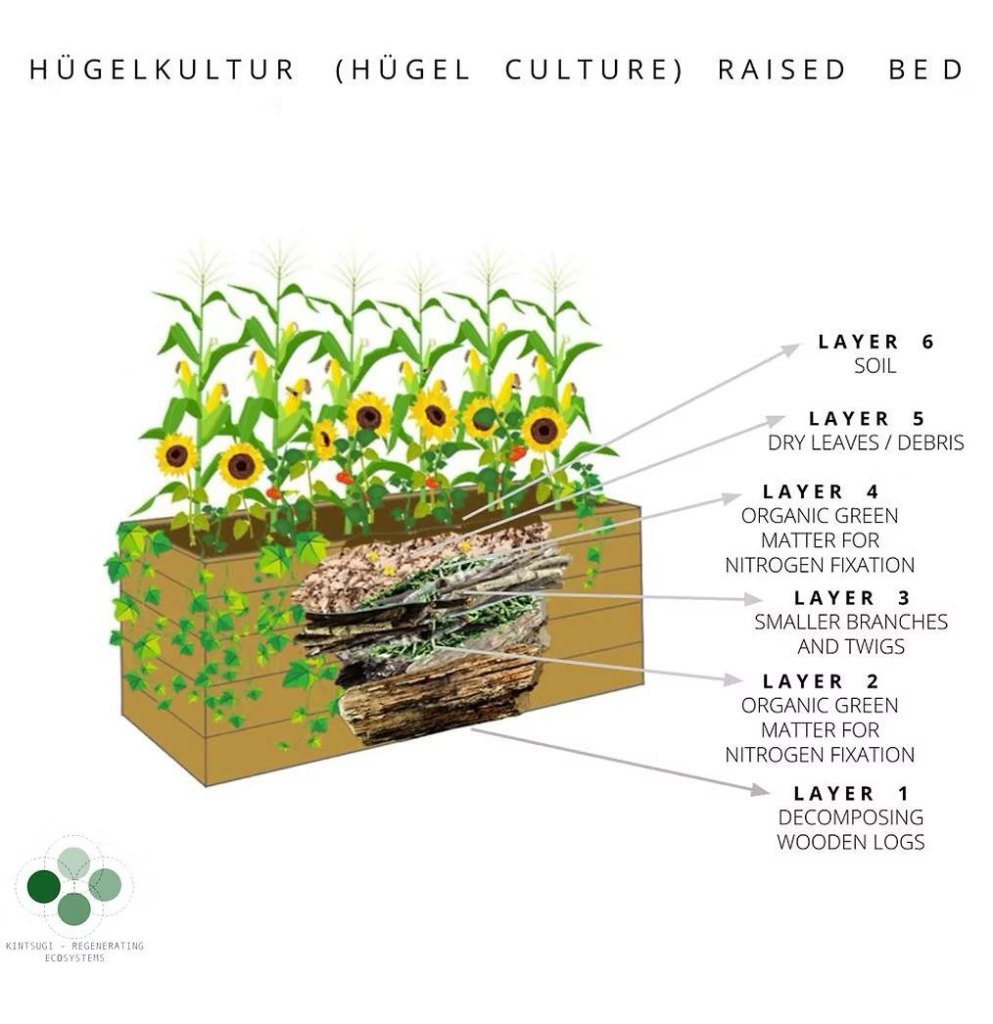
At its core, hügelkultur is a form of biomimicry. In a forest, trees fall to the ground, slowly accumulating leaves, debris, and organic matter on top of them. Over time, this breaks down into rich, fertile soil, creating the perfect base for new life to grow. Hügelkultur brings this exact process into our gardens.
Hügel beds are no dig raised beds that hold moisture, build fertility, and maximise surface area, often leading to higher yields over time.
Hügel beds can either be built and left to decompose for a few months before planting, or they can be planted immediately. In the first year, due to high carbon content, the beds may face nitrogen deficiency. Over time, they naturally balance out and become nitrogen rich. To support this process early on, it is helpful to add nitrogen rich materials such as green leaves or urine while building the bed.
Here is how you can make your own hügel bed:
1. You can use a metal trunk, wooden crate, fallen log, or simply mark out a space on the ground. The structure can be as creative as you want it to be.
2. Start layering from the bottom up. Begin with thick semi rotten logs as the base, followed by thinner branches, then twigs, dry leaves, and debris. After each carbon layer, add a layer of nitrogen rich material. We did not do this consistently at first, which led to nitrogen deficiency, and we had to supplement later.
3. Once the bed reaches your desired height, or is left with about 5 to 10 cm of space at the top, add a layer of soil to make it ready for planting. If you prefer to wait, you can let it sit and decompose further, and add soil later when you are ready to plant.
4. You can enrich the top layer with charcoal inoculated with urine, and even add broken terracotta pieces to help retain moisture. These can also be pre charged with nutrients. Then go ahead and plant or sow your seeds.
5. Our hügel bed requires about 60 percent less water than regular beds. We water it roughly once every 10 days. In some cases, hügel beds can even be irrigation free. The buried wood creates a fungal rich environment that holds moisture and slowly releases nutrients.
6. Since these are raised beds, they work very well for root vegetables and deep rooted plants. Crops like pumpkins and potatoes tend to thrive in hügel beds.
You can read more about hügelkultur here:
https://www.permaculturenews.org/2012/03/23/a-recipe-for-a-hugelkultur-raised-bed/ (the process of making hügel bed on the ground)
Have you made one yet? Let us know how it went for you…